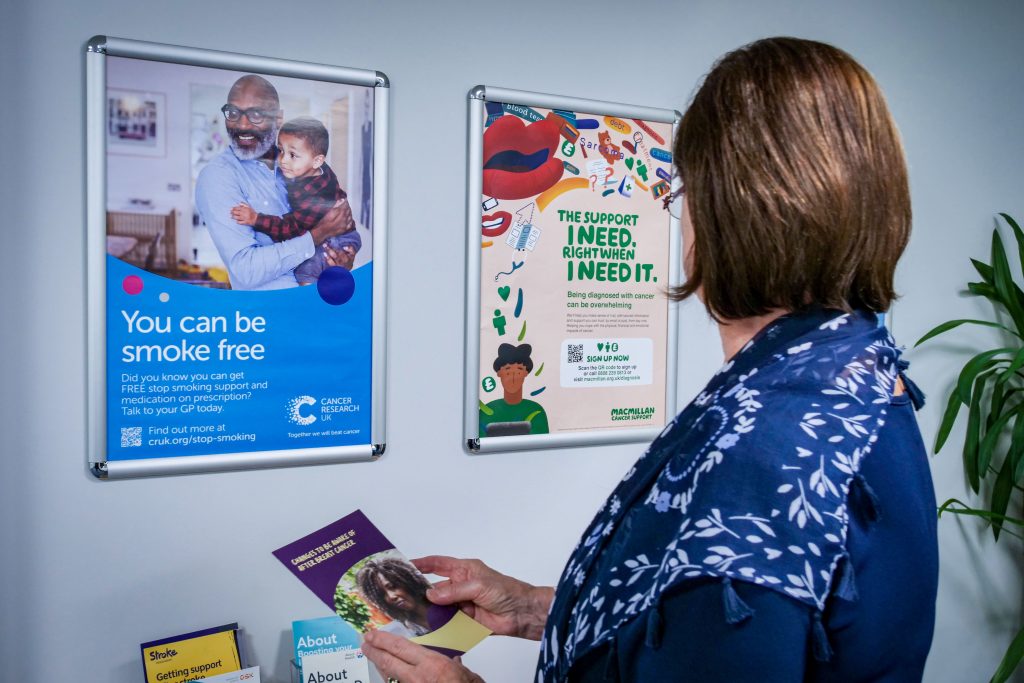
Six key takeaways of effective healthcare out-of-home advertising
- Healthcare out-of-home advertising reaches people when health information is most relevant to them, helping reduce media wastage and improve campaign effectiveness.
- Trusted healthcare environments, including GP practices, hospitals and pharmacies, encourage patients to engage with health messages and take action.
- Longer dwell times allow healthcare campaigns to educate as well as raise awareness, creating opportunities for more meaningful engagement.
- The most effective healthcare campaigns combine multiple communication formats, supporting patients at different stages of their healthcare journey.
- Clear, accessible messaging helps more people understand information, recognise its relevance and feel confident taking the next step.
- Successful healthcare out-of-home advertising starts with strategic planning, ensuring the right message reaches the right audience in the right environment.
Out-of-home advertising for healthcare campaigns: why healthcare plays by different rules
When marketers think about out-of-home (OOH) advertising, they often picture roadside billboards, bus shelters or large-format digital screens competing for attention in busy public spaces.
It’s easy to see why. Traditional OOH is built around visibility, reaching as many people as possible as they go about their daily lives.
Healthcare campaigns play by different rules.
Reaching the largest audience isn’t always the objective. The objective is to reach the right people, at the right time, in an environment where they are receptive to information that could improve their health.
That changes the role of out-of-home advertising entirely.
“Traditional out-of-home has always been associated with mass audiences,” says Dean Gahagan, Joint Managing Director at IDS Media.
“The challenge is that mass audiences also create wastage. In healthcare environments, you’re speaking to people who are already engaged with their health, so the message becomes significantly more relevant.”
This shift from broad reach to targeted relevance is what makes healthcare OOH such a powerful communication channel.
Healthcare environments create qualified audiences
One of the biggest misconceptions surrounding out-of-home advertising is that success depends on reaching the largest audience possible.
In healthcare communication, relevance matters far more than volume.
Healthcare environments allow organisations to reach people at the moment information is most relevant to them.
One campaign that illustrates this perfectly was IDS Media’s work with Help for Heroes, the charity supporting veterans and their families.
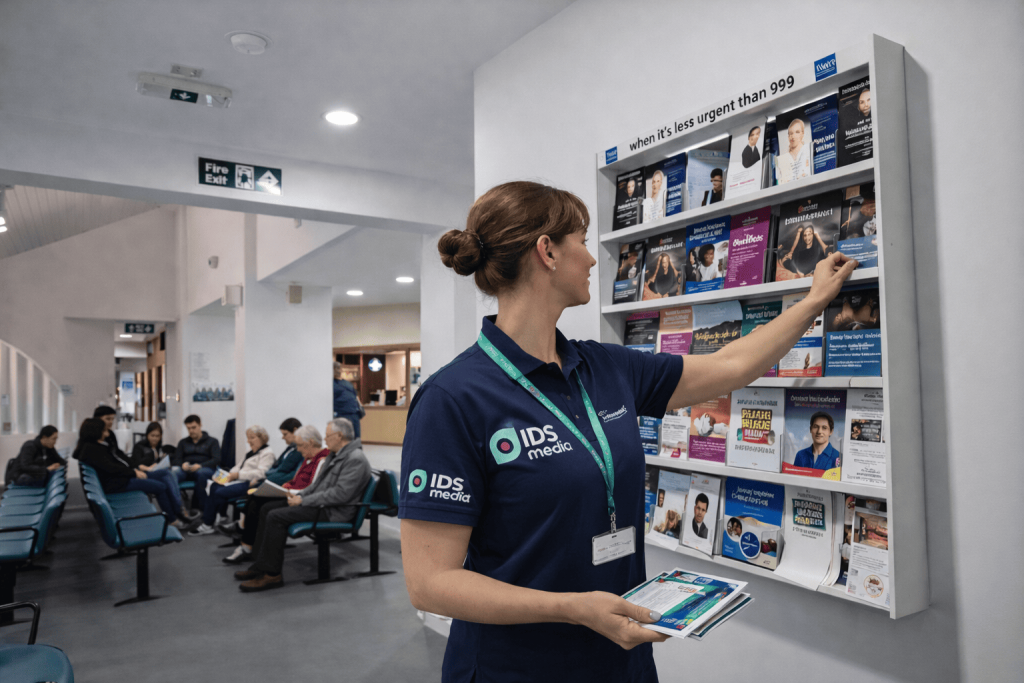
Rather than relying on broad public advertising, the campaign placed posters, digital screens and printed materials within GP practices and hospitals, reaching veterans in trusted healthcare environments where they were already engaging with health services.
The campaign also combined clear, empathetic messaging with multiple ways to respond, including a QR code, website and telephone number, making it easy for different audiences to access support.
Importantly, the campaign didn’t rely on a single poster or advert. Posters created initial awareness, printed materials provided more detailed information, and the trusted healthcare environment encouraged conversations between veterans, their families and healthcare professionals. Every touchpoint reinforced the last, building confidence and making the next step feel straightforward.
The result was a 400% increase in registrations compared with the charity’s other media activity, demonstrating how audience understanding and careful channel selection can dramatically improve campaign performance.
For Dean, the campaign highlights a wider lesson.
“The objective isn’t to reach more people. It’s to reach the right people, in the right environment, at the point they are most likely to engage.”
That’s the difference between buying media and planning a healthcare communication strategy.
Healthcare out-of-home advertising offers something traditional OOH rarely can: time
Traditional out-of-home advertising often has just a few seconds to make an impression.
Healthcare environments work differently. Patients spend time waiting.
According to YouGov research, 73% of patients spend at least five minutes in a GP practice, while more than a third remain there for over 10 minutes.
That creates opportunities that simply don’t exist beside a motorway or on a railway platform.
“Waiting rooms completely change the conversation,” says Dean. “People aren’t walking past a poster in two seconds. They might have 10 or 20 minutes to engage with information, whether that’s through posters, digital screens or printed leaflets.”
This longer dwell time allows healthcare campaigns to educate rather than simply attract attention.
It also supports multiple communication formats working together.
A digital screen or poster may introduce an issue. A leaflet can provide more detailed information. Healthcare professionals can then continue that conversation during the appointment itself.
Rather than a single advertising touchpoint, healthcare environments become part of a broader communication journey.
Trust changes everything
Context matters.
People don’t consume health information in the same way they consume advertising for holidays, fashion or entertainment.
Healthcare requires credibility.
That is where healthcare environments have a significant advantage.
YouGov’s research found that 86% of patients trust health messaging within GP practices. Pharmacies achieve 72%, while hospitals reach 71%. Traditional media channels score dramatically lower.
Dean believes that environment influences how messages are perceived.
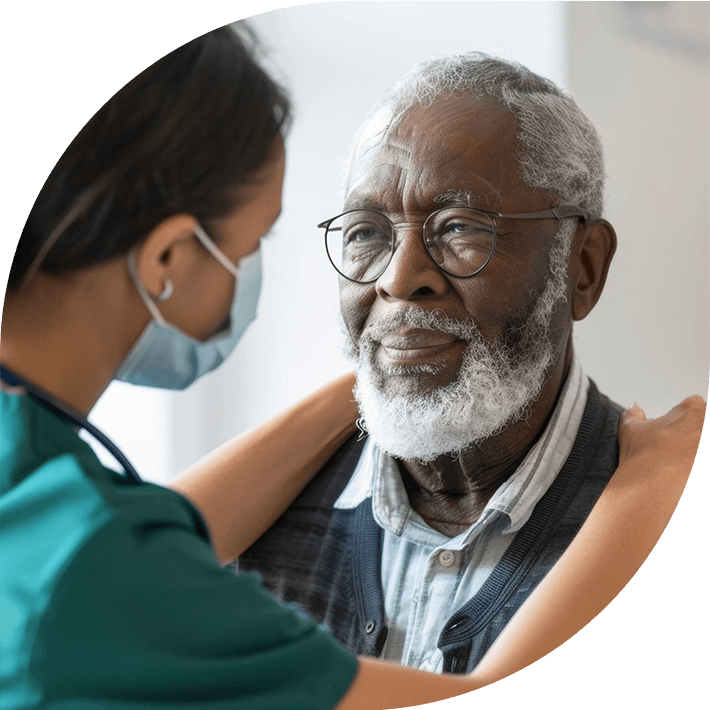
“Patients are already thinking about their health when they’re sitting in a GP surgery or hospital waiting room,” he says. “They’re surrounded by healthcare professionals, and that creates an implied endorsement for the information they’re seeing.”
This trusted context encourages patients to take health messages seriously.
Unlike many digital channels, healthcare environments also provide an immediate opportunity for action.
“If someone reads a leaflet about high blood pressure while they’re waiting to see their GP, they can ask about it during the appointment,” adds Dean. “The pathway from awareness to action is incredibly short.”
Healthcare out-of-home strengthens digital campaigns
Healthcare marketers often think about digital and out-of-home as separate channels.
Dean sees them as complementary.
“In many cases, out-of-home validates digital activity,” he explains. “People might see something online, but when they encounter that same message in a trusted healthcare environment it becomes tangible. It reassures them that the organisation is genuine and that the service is real.”
Physical media provides reassurance in an online world where misinformation, unverified content and AI-generated material continue to grow.
Rather than competing with digital channels, healthcare OOH helps validate them, giving patients greater confidence that the information they’re seeing is genuine and trustworthy.
Patients see the same message across multiple trusted touchpoints, increasing both familiarity and confidence.
Community hubs create smarter targeting
Healthcare settings are more than clinical environments.
They’re community hubs.
Most patients visit GP practices, pharmacies and hospitals close to where they live, making these locations highly effective for reaching defined local populations.
That creates opportunities to deliver campaigns with exceptional precision, reducing media wastage while improving relevance.
“Location plays a huge role,” says Dean. “No one travels 50 miles to visit their GP.
“Health conditions vary between different communities, age groups and ethnic populations. The more accurately you understand those audiences, the more efficiently you can use your budget.”
IDS Media regularly uses demographic and NHS data to help clients identify where campaigns will have the greatest impact.
Whether responding to regional disease outbreaks or targeting communities with a higher prevalence of particular conditions, strategic location planning allows organisations to reduce waste while improving outcomes.
This is where healthcare communication becomes less about media buying and more about strategic planning.
Clear communication drives better engagement
Even the best media strategy can fail if the creative doesn’t connect.
Healthcare audiences don’t respond to complicated scientific language or technical terminology.
They respond to clear, practical communication.
“Sometimes clients send us materials full of language that only clinicians would understand,” says Dean. “Patients shouldn’t have to search online to understand whether a message applies to them.”
He recalls seeing terminology such as “comorbidities” used within patient-facing campaigns.
“Most people don’t use that word,” he explains. “If you simply say ‘people living with multiple health conditions’, far more patients immediately understand the message.”
Clear language removes barriers.
It allows more people to recognise themselves within the communication and feel confident taking the next step.
The same principle applies to design. Large readable typography. Clear hierarchy. Accessible colour choices. Representative imagery. Simple calls to action.
Every creative decision should help patients understand the message rather than making them work harder to interpret it.
Great campaigns respect the patient journey
Perhaps the biggest lesson from healthcare out-of-home is that successful campaigns rarely rely on a single advertising format.
Patients move through multiple healthcare environments.
The strongest campaigns recognise this.
A poster may create awareness. A leaflet provides deeper education. Healthcare professionals reinforce the message through conversation. Digital activity continues the engagement after patients leave the practice.
Each touchpoint builds confidence. Each reinforces the last.
Rather than asking where advertising should appear, healthcare marketers should first ask where patients are on their healthcare journey.
That question changes everything.
Strategic thinking delivers better healthcare communication
Out-of-home advertising has always been an effective awareness channel.
Healthcare environments elevate it into something far more valuable.
Longer dwell times. Highly targeted audiences. Trusted settings. Immediate opportunities for action.
When combined with thoughtful planning and patient-centred creative, healthcare out-of-home becomes far more than a media placement.
It becomes part of the care pathway itself.
Healthcare campaigns really do play by different rules, as Dean concludes: “Healthcare communication works best when it’s planned around people, not channels. Once you understand the patient journey, you can choose the right environments, the right formats and the right message to genuinely help people make better decisions about their health.”
For healthcare organisations looking to improve campaign effectiveness, that’s perhaps the most important lesson of all.
Get in touch to discuss your next healthcare campaign.
Source: YouGov research, analysed by IDS Media UK