
Six key takeaways from successful community health campaigns
- The most effective community health campaigns start with understanding the audience, not choosing the channel.
- Different communities have different needs, behaviours and motivations, so a one-size-fits-all approach rarely delivers the best results.
- Audience insight and local knowledge help organisations create more relevant, targeted and effective healthcare communication.
- Trusted influencers, families and community networks can create a powerful ripple effect that extends campaign reach beyond the original message.
- Awareness is only the first step – successful campaigns support long-term engagement and behaviour change.
- Strong community health campaigns combine research, strategy, creative development, delivery and measurement into one joined-up approach.
Why effective health awareness campaigns start with understanding communities
Most health awareness campaigns begin with a message.
The strongest campaigns begin with an audience.
Who are we trying to reach? What matters to them? What barriers might prevent them from engaging? And what will motivate them to take action?
These questions sit at the heart of every successful community health campaign.
Because communities are not all the same.
Different audiences have different experiences, behaviours, concerns and communication preferences. What resonates in one town, demographic or community group may have little impact elsewhere.
For organisations planning community health campaigns, appreciating those differences is often the first step towards meaningful engagement.
Why one-size-fits-all campaigns rarely work
Healthcare communication is ultimately about people.
Yet many health awareness campaigns are still built around broad assumptions about audience behaviour.
As Dean Gahagan, Joint Managing Director at IDS Media, explains: “The first question shouldn’t be where you advertise. It should be who you’re trying to reach.
“That audience-first mindset shapes everything that follows. A campaign aimed at younger adults will require a different approach to one designed for older people.
“A message intended for a culturally diverse community may need different language, imagery or communication channels.
“And a local charity operating within one town will face different challenges to a national organisation running a UK-wide campaign,” he adds.
Recognising those differences helps organisations make better decisions about messaging, creative design and channel selection. It also helps shape a communication strategy that reflects the needs of the community rather than assumptions about it.
Community health campaigns start with insight
One of the biggest misconceptions surrounding community advertising is that success is driven primarily by media placement.
Dean believes the reality is far more nuanced.
“The channel is important, but knowing the audience is even more important,” he says.
For IDS, this is where strategy begins. Before discussing channels or formats, the team focuses on understanding the audience, the challenge and the outcome the organisation is trying to achieve.
This can involve analysing:
- Local demographics
- Audience behaviours
- Healthcare needs
- Community characteristics
- Geographic hotspots
- Cultural considerations
And the objective is clear.
Identify where target audiences are most likely to engage and build a strategy around those insights.
For smaller charities and public health organisations working with limited budgets, this can be particularly valuable.
Rather than trying to reach everyone, campaigns can focus resources where they are most likely to make a difference.
The people who influence behaviour
Healthcare communication isn’t only influenced by organisations.
It’s influenced by people.
- Families.
- Friends.
- Community leaders.
- Healthcare professionals.
- And often, parents.
Sharing a simple example, Dean said: “I still use the toothpaste my mum told me to use when I was about eight years old.”
It’s a light-hearted example, but the point is an important one.
The people closest to us often have a lasting influence on our behaviours, decisions and habits. That influence doesn’t disappear when we become adults.
This is one reason community health campaigns can be so effective.
When messages reach influential people within communities, those messages often travel further through conversations, recommendations and personal experiences.
“That’s where you start to see the ripple effect,” says Dean. “A message seen by one person can quickly spread through families, friendship groups and communities, creating conversations that extend far beyond the original campaign.”
For public health organisations, knowing who holds influence within a community can be just as important as understanding where that community spends its time.
Speaking the language of the community
Effective communication is more than translating words.
It’s about making messages accessible, relevant and meaningful.
Different communities may have different language requirements, cultural considerations or communication preferences.
Dean believes organisations should think carefully about how information is presented.
Whether that means producing materials in multiple languages, creating Welsh-language campaigns, or adapting creative content for specific audiences, the goal remains the same:
Help people access information in a format that works for them.
When audiences feel understood, engagement tends to improve.
Awareness is only the beginning
Many health awareness campaigns are designed to encourage behaviour change, but awareness alone is rarely enough.
Dean points to examples such as weight-management programmes and lifestyle interventions.
“People may understand what they need to do,” he says. “They may even take action initially. The challenge is often sustaining that behaviour over time. This is where community-based communication can play an important role.
“Rather than delivering a single message and moving on, successful community health campaigns often create ongoing visibility, reinforcement and support.
“The most successful campaigns continue supporting people long after they’ve first seen the message,” he says.
Why local knowledge is so important
Communities are shaped by local factors.
- Population demographics
- Health inequalities
- Cultural influences
- Geography
- Access to services
What works in one location may not work somewhere else.
As Dean explains, organisations often benefit from taking a more localised approach.
“A campaign targeting residents in Blackpool, for example, may require a different strategy to one targeting communities in Cardiff, Birmingham or York.
“Identifying those local differences helps organisations communicate more effectively and use resources more efficiently.”
Why strategy matters more than channels
One of the strongest themes running through successful community health campaigns is strategic planning.
For IDS, the conversation doesn’t begin with media channels. It begins with defining the challenge.
- Who needs to be reached?
- What barriers exist?
- What outcomes are we trying to achieve?
Dean says: “Many organisations start by asking where they should advertise. We prefer to start by understanding the audience, the challenge and the outcome they’re trying to achieve.”
From there, the IDS team can support every stage of the process including:
- Research
- Audience analysis
- Campaign strategy
- Creative development
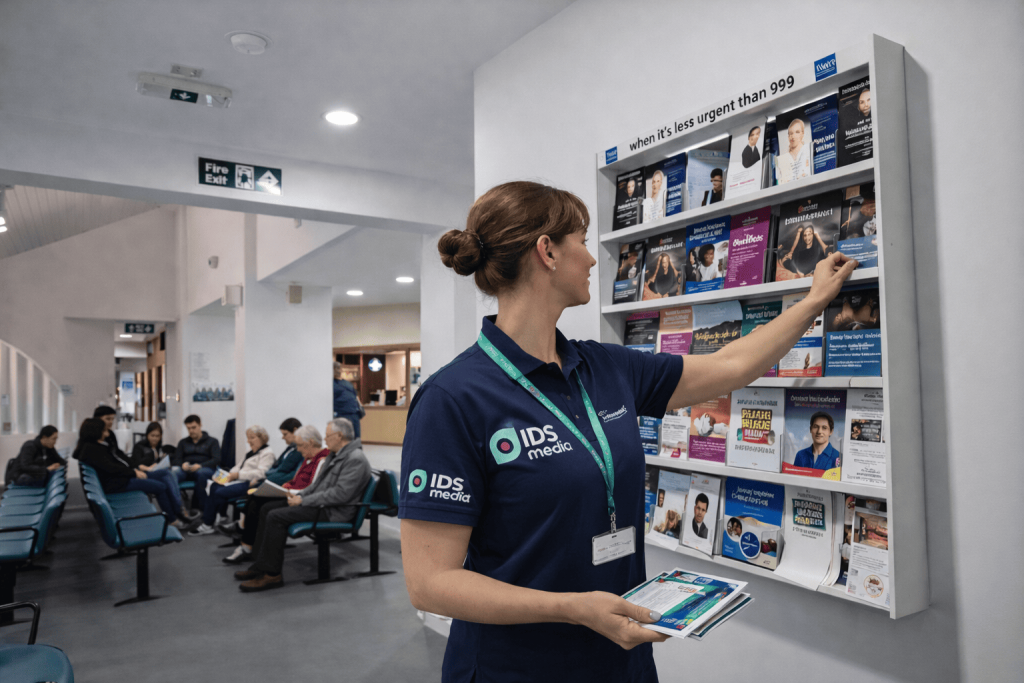
- Community advertising
- Healthcare environments
- Campaign delivery
- Measurement and reporting
“Whether a client needs support with research and planning, creative development, campaign delivery or reporting, IDS can manage the entire process from concept through to measurement,” said Dean.
The British Heart Foundation example
One example Dean highlights is IDS Media’s work with the British Heart Foundation.
The campaign focused on CPR awareness and encouraged people to learn life-saving skills.
Success wasn’t measured solely by impressions or visibility. The wider objective was to encourage action and potentially save lives.
The campaign demonstrates an important principle. Success in healthcare communication isn’t always measured by clicks, impressions or awareness alone.
Sometimes success is measured by the actions people take afterwards.
“If one person learns CPR and uses it when it matters most to save a life, then that’s a powerful outcome,” said Dean.
Final thoughts
Dean believes one of the biggest mistakes organisations make is assuming that everyone will respond to the same message in the same way.
Successful community health campaigns recognise that people are influenced by different experiences, different communities and different motivations.
That’s why effective healthcare communication starts with listening, knowing the audience, recognising community needs, and identifying what will genuinely help people take action.
“It’s about finding the right message, for the right audience, in the right place,” said Dean.
Get in touch to discuss your next healthcare campaign.