Six key takeaways for healthcare communication campaigns
- Healthcare waiting rooms create a unique mindset where patients are already focused on their health, making them more receptive to relevant messaging and support.
- Trust plays a major role in healthcare communication, with patients far more likely to engage with health information seen in GP surgeries, hospitals and pharmacies than traditional media channels.
- Longer dwell times in waiting rooms allow healthcare campaigns to move beyond awareness and support stronger patient engagement, education and action.
- Education-led healthcare campaigns are often more effective than hard-selling approaches because patients are looking for reassurance, understanding and clear next steps.
- Waiting room media can help improve conversations between patients and healthcare professionals by giving both audiences access to clearer, more informed information.
- The most effective healthcare campaigns use relevance, timing and trust to influence meaningful patient behaviours rather than simply increasing visibility.
Why waiting room media drives behaviour change in healthcare campaigns
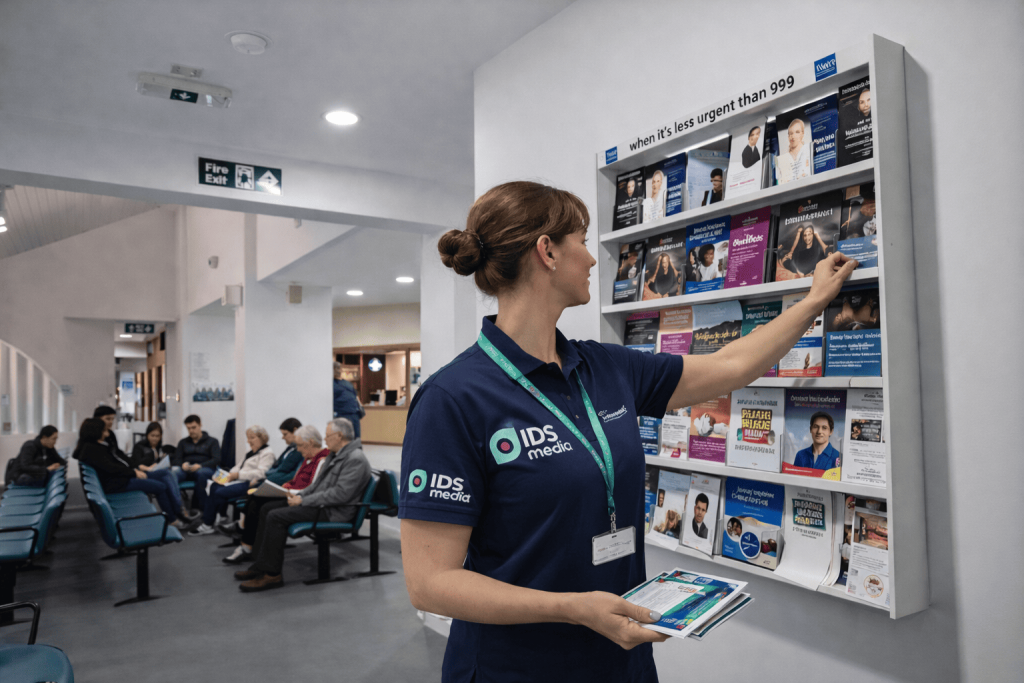
When people think about waiting room advertising, they often think about awareness alone. A poster seen in passing. A leaflet picked up out of boredom. A screen glanced at while waiting for an appointment.
But healthcare environments work very differently from traditional media spaces.
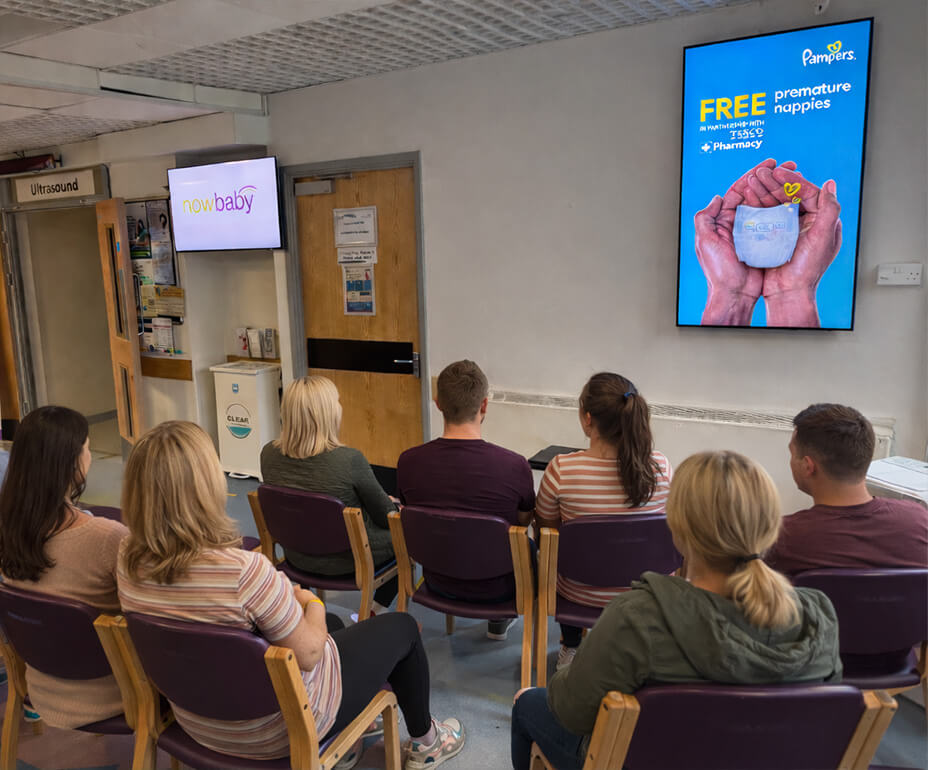
In GP surgeries, hospitals and clinics, people are not passively waiting for appointments. They are actively thinking about their health, looking for answers and, in many cases, emotionally invested in what happens next. That creates a very different healthcare communication dynamic – one where health messaging can influence real decisions, conversations and behaviours.
YouGov research found that 94% of patients notice health messaging in GP waiting rooms, while 62% take action after seeing health information in a GP practice.
For healthcare brands, charities and public health organisations, that changes the role of waiting room media within healthcare campaigns entirely.
Healthcare environments create a different mindset
One of the biggest differences between healthcare environments and traditional out-of-home advertising is mindset.
Patients sitting in a waiting room are already focused on their health. They are often preparing for an appointment, thinking about symptoms, concerns, treatment or next steps. Unlike other advertising environments, healthcare messaging appears at a moment when health is already front of mind.
Dean Gahagan, Joint Managing Director at IDS Media, believes that emotional context is what makes healthcare communication more powerful in these settings.
“When someone’s talking about your health, it’s probably the most personal conversation you can arguably have. You’re there looking for answers – whether it’s a concern, a condition or something more serious – and your mindset changes completely,” he said.
That difference matters.
According to YouGov research, 93% of patients in GP environments say they are open to improving their health.
Patients are not simply waiting to pass time. They are actively receptive to information that could help them better understand their health, symptoms, treatment or lifestyle.
Why does dwell time matter in healthcare communication?
Traditional out-of-home advertising often relies on speed. A roadside billboard or transport advert may only have a few seconds to capture attention.
Healthcare waiting rooms create opportunities for much deeper engagement.
Patients may spend several minutes – or much longer – inside the environment, creating opportunities for deeper engagement and more educational forms of healthcare communication.
YouGov research found that 73% of patients spend five minutes or more in GP waiting rooms, with over a third waiting more than 10 minutes.
That extra time changes how people engage with health messaging.
“High dwell time gives people time to absorb information and potentially action it there and then,” said Dean. “They can scan a QR code, pick up a leaflet, research something on their phone or even start thinking about questions they want to ask their healthcare professional.”
Dean also points out that patients often begin searching for information simply because they are mentally available in that moment.
“You get to a point where you’re tired of staring at your phone or looking around the room, so you start reading information around you. Sometimes people pick up leaflets that have nothing to do with them initially, simply because they have time to engage with them.”
Trust plays a critical role in behaviour change
Trust is one of the most important drivers of behaviour change in healthcare communication.
People are unlikely to act on health information unless they believe the environment – and the message itself – is credible.
That’s where healthcare settings have a major advantage over many traditional media channels.
YouGov research found that GP practices are trusted by 86% of patients as a source of health information, compared with just 5% for social media and 4% for TV advertising.
Dean believes the difference between a healthcare environment and a social platform is significant.
“If you see healthcare messaging on TikTok, you’re probably less likely to trust it. But if you see that same message in a GP surgery or pharmacy, it immediately carries more gravitas because of the environment you’re in.”
This level of trust creates opportunities for healthcare campaigns that go beyond awareness and into genuine behaviour change.
The strongest healthcare campaigns complement the clinical environment
Healthcare audiences respond differently from consumers in retail environments.
In waiting rooms, education-led messaging consistently performs better than aggressive commercial messaging because patients are looking for reassurance, clarity and understanding.
Dean believes successful healthcare campaigns are those that help patients feel informed enough to take a next step.
“People are unlikely to act if they don’t understand what happens next. The campaigns that work best are the ones that educate people properly and give them a clear direction – whether that’s speaking to a clinician, visiting a website or asking for support.”
This is particularly important for public health communication and condition awareness campaigns, where behaviour change often depends on confidence and understanding.
IDS Media has increasingly focused on campaigns that help organisations create more meaningful conversations between patients and healthcare professionals (HCPs) rather than simply driving visibility.
Why is shared understanding important in healthcare communication?
Some of the most effective healthcare campaigns are those that educate both audiences at the same time.
IDS Media’s work with the British Heart Foundation is a strong example of this approach, combining patient-facing materials with HCP support packs to encourage more informed conversations around heart health and medication support.
The approach included educational leaflets, waiting room posters and resources designed to help patients ask better questions during appointments.
Dean described this as creating a “full-circle” communication strategy.
“The gold dust is when both the patient and the healthcare professional are educated on the same service. The patient feels more confident asking questions, and the HCP feels more confident recommending support or signposting them in the right direction.”
This approach reflects a broader shift in healthcare communication – away from passive advertising and towards enabling better patient conversations.
Real-world healthcare campaigns can influence outcomes
One example of this in practice was IDS Media’s support of Nurofen’s “Gender Pain Gap” campaign, which aimed to help women have more effective conversations with HCPs about pain.
As part of the campaign, Nurofen created a “Pain Pass” booklet that allowed women to track symptoms and pain patterns before appointments. IDS Media distributed the materials through its national waiting room network so patients could access the tool at the point of need.
Dean believes the campaign worked because it focused on practical patient support rather than promotion.
“It wasn’t simply saying ‘buy this product’. It was helping patients explain what they were experiencing more clearly so healthcare professionals could make better decisions. That’s where healthcare communication becomes genuinely valuable.”
Waiting rooms are not traditional out-of-home environments
SOne of the biggest misconceptions about waiting room media is that organisations treat it like conventional out-of-home advertising.
But healthcare environments operate differently.
“A billboard or roadside advert might only have two seconds to make an impression,” said Dean. “It’s also reaching lots of different demographics at once, many of whom may have no relevance to the message. In waiting rooms, you’ve got the opportunity to tell a story, provide education and explain why something matters.”
That changes the creative approach entirely.
Instead of short commercial messaging, healthcare campaigns can focus on:
- Education
- Reassurance
- Symptom awareness
- Condition management
- Practical support
- Clear calls to action
The result is a more meaningful form of patient engagement – one built around relevance, trust and timing.
The future of healthcare communication is behaviour-led
The value of healthcare communication is no longer measured purely by visibility or reach.
Increasingly, success comes from creating moments that help people ask questions, seek support and take meaningful action around their health.
And in healthcare environments – where trust, attention and relevance already exist – those moments become far more powerful.
Get in touch to discuss your next healthcare campaign.
Source: YouGov research